

Government ring-fences $15 million towards $30 million biomanufacturing raise
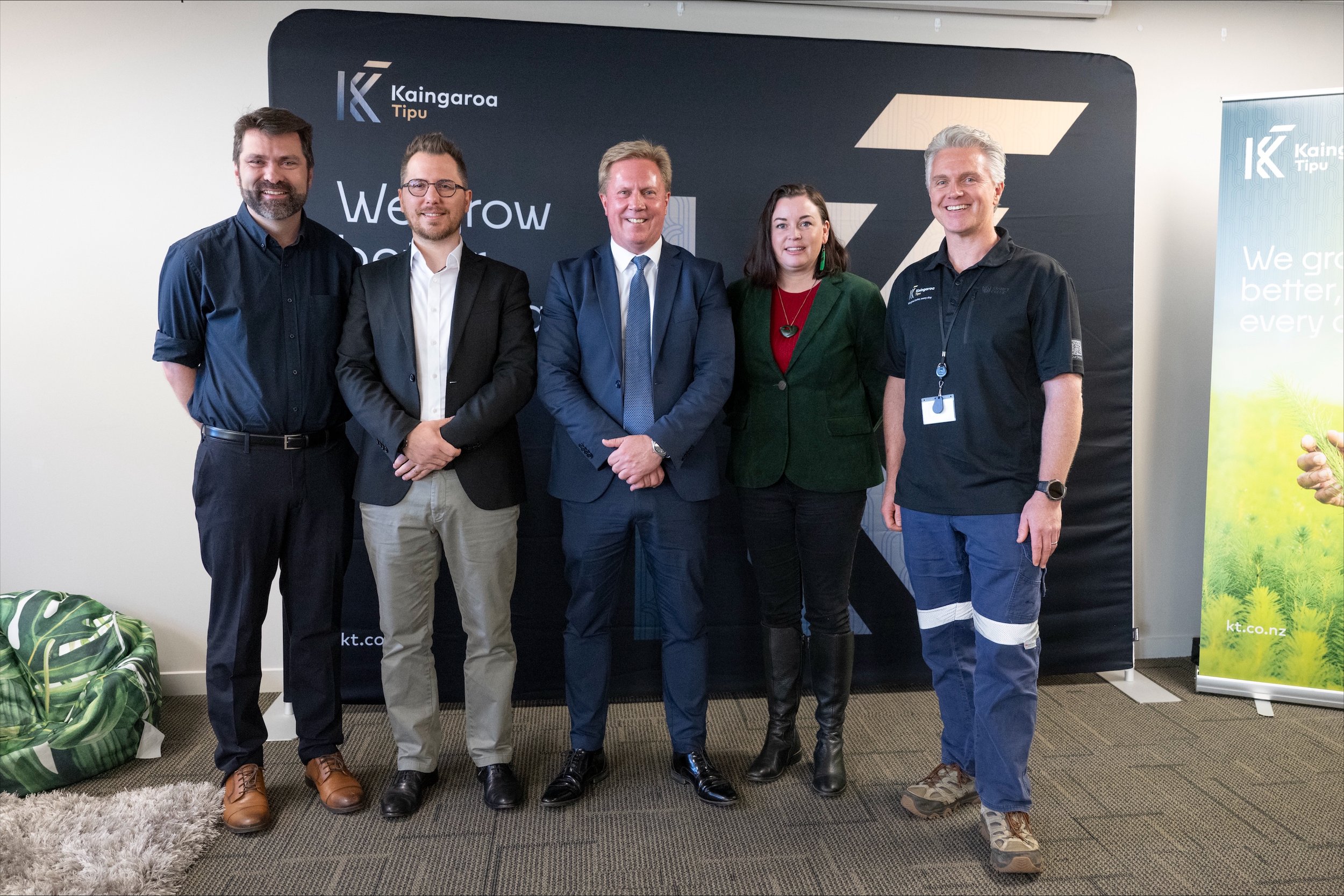
From left, Bioeconomy Science Institute bioproducts portfolio leader Alec Foster, Sequal structural products manager Andrea Stocchero, Forestry Minister Todd McClay, BioFactory interim chief executive Claire Stewart and Kaingaroa Tipu chief executive Ryan Cavanagh at the BioFactory funding announcement in Rotorua.
Based in Rotorua, the BioFactory will turn low-value or waste forestry, agriculture and marine by-products into high-value ingredients, at a scale supporting commercial production.
Government support for New Zealand’s first ‘BioFactory’ will unlock private investment in shared infrastructure that transforms low-value primary sector commodities and waste into high-value ingredients for industries ranging from health and nutrition to advanced materials and pharmaceuticals.
Today’s announcement by Minister of Forestry Todd McClay will see the government, via the Ministry for Primary Industries, ring-fence $15m towards a $30m capital raise, conditional on a further $15m being secured from private investors. Kaingaroa Tipu (formerly Timberlands) has already committed $2m.
Separate to the capital raise, a further $20m investment is expected from a property developer. The facility is expected to be designed next year, built in 2028 and operational in 2029.
BioFactory Chief Executive Claire Stewart says biomanufacturing facilities are common overseas, with government funding the critical step in attracting the additional investment that makes them a reality.
“New Zealand has small pilot plants for testing new bio-based products, but they are typically designed for a single process and feedstock and are often too small to prove commercial viability.
"Businesses that have proven their science at lab or pilot scale have effectively had two options: invest in their own costly facility before completing the scale-up process, or go overseas for scale-up validation, potentially putting their IP at risk,” says Stewart.
“The BioFactory closes that gap with a single, shared site where companies of any size can test and scale their product using real feedstock at volume before committing to build a plant of their own.”
Stewart says there is growing demand from global manufacturers for fossil free ingredients such as proteins and resins that could be produced here using our abundant biomass.
“New Zealand is great at producing commodity products like logs and milk powder, but there is much more value we can capture. We currently import high-value specialty chemicals and ingredients made from petrochemicals that could instead be made from biomass. The BioFactory will help turn our side and waste streams into these high-value products, creating new revenue, intellectual property and jobs here in New Zealand.”
Kaingaroa Tipu Chief Executive Ryan Cavanagh says the company has been the first private investor in the BioFactory because it believes it can change what a forest can be worth to New Zealand.
“Kaingaroa Tipu manages New Zealand’s largest sustainable harvest forest. We see the BioFactory as the way to unlock whole-of-tree value from wood that is currently sold into lower value markets.”
Radiata pine producer Sequal is supportive of the BioFactory, with Chief Executive David Turner saying the company sees the importance of this investment for New Zealand industry.
“We see first-hand how much low value material moves through this industry every year. The BioFactory will give that material somewhere to go, beyond commodity markets, into higher value products we can’t currently make here.”
The New Zealand BioFactory concept has been led by the NZ Product Accelerator with close support of the Bioeconomy Science Institute Maiangi Taiao.
Dr Alec Foster, the BSI's Bioproducts Portfolio Leader, has been the Science and Engineering Lead since the project's inception.
"We are building something to deliver products the world needs. Demand for biobased ingredients is reshaping how global brands source their raw materials. Unilever, Lululemon and food ingredient manufacturer ADM are already sourcing fermentation-derived ingredients and bio manufactured materials for their products,” says Dr Foster.
New Zealand’s first BioFactory will follow the introduction of government-backed biofactories in the UK, Canada, Germany and Belgium.